This year’s personal March Odyssey was extra special for me because in Indianapolis, I got to crash Oakland University's title celebration on Tuesday night. A little background seems in order…
Where It Started
It was a gloomy Monday morning for a Valpo fan, though the weather was bright
and sunny in downtown Tulsa in early March of 2005. You see, we were
used to being the Kings of the Mid-Con. I was later to that party than
most Valpo fans, but I’m sure I was still struggling to process getting
bounced in the quarterfinals. The Men had been in every title game going
back at least a decade, and the Women had been there each of the previous 3
years. I suppose it is possible I was headed over to the UMAC (Union
Multipurpose Athletic Complex) for the women’s semifinals because I wasn’t
used to having to think about going home early. By the way, I wasn’t the
only Valpo fan by far who was doing the same.
Looking back on it 19
years later, I’d rather say that I had become hooked on conference tournament
basketball – once a year, go somewhere for 4 or 5 days and just pig out on
elimination basketball. Because, except for 8 years in the Horizon
League, that’s what I’ve done every single year since, through thick and thin
Valpo-wise.
Or perhaps it was because that Monday morning as I
scanned the lobby of my hotel for Mid-Con celebrities, Greg Kampe, coach of
the Oakland Golden Grizzlies, noticed me and waved for me to come over.
Let me set some context here.
Picture a Valpo fan, whose team at
the time was 15-0 lifetime against Oakland, parading around in a 2004
championship T-shirt with Valpo all over it, being summoned to a chat with the
coach of that Oakland team. Why? is a question I imagined going through
the minds of any Golden Grizzlies fan who might have spied this chance
encounter. We talked about anything and everything. He shared an
embarrassing and amusing anecdote regarding a mishap with their practice
jerseys. We revisited the surprising first round exit he presided over 2
years prior in Kansas City. He related his view of our game against
Chicago State, including Homer Drew’s desperate attempt to find the one ref
who was unfamiliar with him and get him to T him up, which did succeed in
getting his team back into contention to advance (we still ended up losing by 5). We must have chatted
for 20 minutes or so before I (hopefully) thanked him for the conversation and
headed over to the UMAC. My own attempt to answer the Why question has
only ever led to the first thing he said to me, something about “I see you at
this thing every year.” I can only guess I was flattered beyond
reason.
Anyway, the championship game the following night between Oakland and Oral Roberts (ORU) was, up
until a few years ago, the most breathtakingly exciting championship game I
have ever attended in person. Not the best, not the most well-played,
and certainly not the most personally gratifying one for me as a Valpo
fan. Simply the most exciting one. For two hours I literally
forgot about the outside world. I was on pins and needles, sitting with
another Valpo fan about 5 or 6 rows behind the Oakland bench, in the midst of
a 6000 seat arena packed to the gills with ORU fans (ORU is located in
Tulsa). I could mutter play-by-play in a low voice as the game went on,
secure in the belief that no one around me would be the least bit aware.
That’s how electric it was. Ironically, I don’t remember a single event
in the game except for the winning basket.
In the years since, I
have regularly exchanged emails with Coach Kampe, got him to bring one of his
bobble-heads to Tulsa in 2007 (which he autographed and then gifted to me),
and any time I told him I was going to pay a visit to the O’Rena, he would
have ticket(s) waiting for me at Will-Call. When Oakland finally paid a
visit to the ARC in December of 2011 (Bryce Drew’s first year as head coach),
and then Oakland joined the Horizon League, I would try my best to get to the
ARC an hour before tipoff and would always be able to say hi and chat with
him. Mind you, I was far from the only Valpo fan who he would exchange
pleasantries with. Greg Kampe is one of a kind.
All of which
is to say that this year’s annual March Odyssey will forever be known as the
Oakland trip, with the bonus of sitting at home (because after 32 games in 14
days at 4 different venues, I am DONE) and thoroughly enjoying Oakland’s
victory over Kentucky. Like Oakland fans, it may take me awhile to find
enjoyment in their OT loss to NC State. But my journey hit its peak, its
climax on a Tuesday night in Indianapolis at Indiana Farmer’s Coliseum when
Oakland finally won their first Horizon League tournament championship.
More on that special night later.
A Plethora of Starting Points
I noticed everywhere I went in my 2 week College Basketball postseason
journey, all 4 places declared themselves to be a starting point.
At
the Enterprise Center at Arch Madness, before every game came the booming
pronouncement: "March: it starts here!" When I got to Indianapolis,
every session (or every game, I can't remember) began with "March Starts
Here!". In Moline, Illinois at Vibrant Arena at the Mark, every game
began with "March: it starts here!" (same conference and announcer as Arch
Madness, but women this time, so not too surprising). And the First Four
at University of Dayton Arena is the start of the NCAA Tournament, contrary to
the opinion of field-of-64-traditionalists.
More to the point,
every one of these events (and many others just like it around the
country) is a starting point for every team. And, it is very American to
think that "March" is all about you, and nobody else, even if every other team
gets to view it the same way. It's all in the spirit of friendly - but
fiery - competition, you see.
Arch Madness
One of my joys every year is hanging out with a bunch of Valpo fans. This year was no exception (Four of them came down from Valpo, two came from Florida):

I also found a Valpo High School classmate and three of us took a picture. This must have been during the Valpo-Belmont game as I am wearing my bluetooth earbuds listening to the Valpo radio play-by-play.

|
| From the VHS class of 1976, left to right: me, Mel Doering, and Phil Koenig |
Day 1
Traditionally, MVC fans are lucky if day 1 is filled with excitement, especially now that the bottom 8 teams have to play on this day. We have now had two years of experience with 4 games on Thursday, and 5 vs. 12 has been a sleepy blowout each year.
Missouri State (9) vs. Murray State (8)
14:26 left in the first half, Missouri State leads 11-6.
— Jakob Milani (@JakobMilani) March 7, 2024
The Bears are smothering on defense and making themselves at home under the basket with their size advantage. They've made 5 shots, while the Racers are 2-4 from the field.
It started out favoring the Bears, but I assumed that the Racers would recover and turn it into a competitive game. After all, this should be the closest of all the Thursday games, according to the seeds.
Bears have three turnovers since the U16 timeout and haven't scored since.
— Wyatt Wheeler (@WyattWheeler_NL) March 7, 2024
For a short time, it looked like they would recover. The Bears got
sloppy with their passes, and the Racers tightened up on defense. Of
course, that only made it 11-8.
And just like that, it’s a 6-0 run in the last minute for Missouri State.
— Blake Sandlin (@BlakeSandlin) March 7, 2024
Missouri State 20, Murray State 10.
Not really sure what Murray State is attempting to do on offense.
— Blake Sandlin (@BlakeSandlin) March 7, 2024
10 points in 12:15 of game action.
The Bears adjusted and the Racers had some awful turnovers that led to fast
break points. At the under 4 media timeout, the score was 20-13, so
Missouri State took their sweet time turning this into a route, but by this
point, it was beginning to be obvious.
I felt especially bad for
the Racers fan during that timeout who did not know that Ja Morant's jersey
number with the Memphis Grizzlies was 12. Not only that, he had to endure
the ridicule of Todd Thomas, aka "That One Guy" who grabs the mic for the fan
contests while the teams are huddling and the fans at home are being subjected
to commercials.
HALF: Missouri State 27, Murray State 14.
— Adam Wells (@TheAdamBWells) March 7, 2024
Racers shot just 17% in the first half. Finished 1-16 from the floor in the half.
Trying to be nice. But one of the worst offensive halves of basketball the Racers have played.
Missouri State was down 16-0 to Murray State less than three minutes into their game on Valentine's Day.
— Wyatt Wheeler (@WyattWheeler_NL) March 7, 2024
The Bears allowed 14 in the first half against the Racers.
Ouch. By the way, Wyatt Wheeler, the Missouri State beat writer, covered
the game from home because the Springfield News-Leader decided it wasn't worth
sending him to St. Louis. Welcome to mid-major sports coverage in 2024,
folks.
The second half was a struggle just to avoid a massive
blowout, and even that failed. The Racers did manage an 8-0 run to cut
the deficit to 12, and later managed to cut it to 11, but then they
completely ran out of steam.
Given the Racers’ struggles during the
conference season with building big leads and then letting them slip through
their fingers, it was disheartening to see them be unable to even compete in
this game. There is wide consensus throughout the MVC that Murray State
is an outstanding addition to the conference.
I’m not sure if the
same was being said about Valpo in 2017, but it seems possible. I hope
that Murray State is not headed for the same struggles that Valpo has been
through.
Valpo (12) vs. Belmont (5)
Not much to say on this one. Belmont won by 25, losing the 2nd half by
1 because they rested their starters for much of it. Valpo played awful,
but plenty of credit for that goes to Belmont who is just a horrible matchup
for the Beacons.
With almost a completely brand new roster
and a new coach, this season was set up to be a complete failure for
Valpo. It is hard for me to be mad about that. Much like Illinois
State under their first year with Ryan Pedon as head coach, I was determined
not to get bent out of shape about the W-L record – this year. Next
year, I sure hope things get better.
Evansville (10) vs. Illinois State (7)
For the first time in my life, I witnessed Evansville win an Arch Madness game
in person. That was good to see. It was also a close game and
therefore much more fun than the two afternoon games.
It was a defensive struggle. Evansville lead ISU 25-21 at halftime. The second half was equally tense, but the Aces held on for the win.
UIC (11) vs. Southern Illinois (6)
A typical UIC game this season: build a good lead in 1st half, fritter it away in 2nd
half, fight back to force overtime, build lead in 1st OT, fritter it away,
survive to second OT, almost lose grip again, but then:
29 points.
— Hunter Tickel (@ByHunterTickel) March 8, 2024
17 in two OTs combined.
The difference maker and closer in a 84-82 double overtime win over Southwrn Illinois.
Isaiah Rivera folks.
Flames scorch Salukis for the third lower seed win from Day I pic.twitter.com/sN5x9cXvbK
Player of the game. SIU had no answer. None.
During the second half, this guy stopped by to say hi (New Mexico State fan I met last year at Arch Madness):

This year he was in the company of some UNI fans who were friends of his. Also, since NMSU had switched to Conference USA, he was on his way to their conference tournament somewhere east of the Mississippi river.
Also, after the day was complete, an SIU fan reached out to me outside the
Enterprise Center (after his team just suffered a brutal loss) to say he
appreciated that I'm there for the tournament every year (apparently I'm
recognizable) even though Valpo is struggling right now. I was flattered
beyond reason. I love a conference tournament I can attend in
person. This is why I hate campus site tournaments. And I am
grateful to be appreciated like that.
Day 2
Missouri State (9) vs. Indiana State (1)
Interesting game. The Trees typically run a short rotation. A
deeper team might wear them down, though that may be somewhat illusory if ISU
is actually not afraid to go deeper when necessary.
ISU threatened
to run away with it midway through first half, but the Bears recovered to make
it a tight game at halftime, trailing 34-31.
The Bears
were assessed 2 techs in the half, one for excessive hanging on the rim and
one for taunting. On the other hand, ISU had trouble at the rim, with
several layups rejected by MSU shot blockers.
The Trees started the 2nd half strong. It still took awhile for them to put MSU away for
good, but they ended up winning 75-59.
The Carnage begins
During the game, Jeff Goodman reported that SIU was going to dismiss Bryan
Mullins with 1 year remaining on his contract. This was at least the
4th straight year Arch Madness ended a coaching career. Greg Lansing
was let go by Indiana State after losing to Missouri State in the 2021 semifinals. Todd
Licklighter was let go by Evansville after losing to Valpo in the 2022 opening
round. Matt Lottich was let go by Valpo after losing to Murray State in
the 2023 opening round.
At the time, I knew (really everyone
did) that Missouri State's Dana Ford was probably on the hot seat.
Indeed, by the end of Arch Madness, Dana Ford has also been fired.
Perhaps the most inexplicable firing (to me at least) was Luke Yakelich being
let go by UIC. I still don't understand that one.
Then of
course, Darien DeVries got snatched up by WVU because Bob Huggins became
toxic, and Josh Schertz got snatched up by St. Louis University because they
had had enough of Travis Ford.
3 firings, 2 promotions - a total of
5 vacancies needing to be filled. Not exactly glorious times for the
MVC.
Belmont (5) vs. Northern Iowa (4)
This was an extremely competitive close game. Belmont did not shoot as
well as they did against Valpo, but Northern Iowa could never really achieve
true separation.
Evansville (10) vs. Drake (2)
This game was competitive for the first five minutes or so, but then Drake
pulled away and was up 21 at halftime. Evansville never really made it a
game in the second half. Carlos Rosario took a really nasty fall in the
second half and had to be helped to the locker room, but he did return to
action later. Drake was able to rest some of their regulars.
UIC (11) vs. Bradley (3)
HALF | BU 27 UIC 25
— Mason Klemm (@nosam_klemm) March 9, 2024
Not the prettiest half for Bradley with 11 turnovers, but they still lead by a couple. A Toby Okani dunk off a turnover served as a microcosm of the Braves' first half.
Leons leads with 9 points, 8 boards. Duke Deen has yet to score.
As soon as the buzzer sounded, Wardle stomped off to the locker room ahead of
his players (presumably so he could rip them a new one).
For one
half, UIC made a serious play for a rematch with the team they just took to 3
OTs (Drake) toward the end of the regular season.
Then Connor Hickman happened, and then the game was
effectively over.
Day 3
On my way to the Enterprise Center, I shared a Metrolink ride with a father
and son pair of UNI fans. The son (who was still school-age) was very
knowledgeable for his age group. He knew stats on the game UNI had
against the Trees during the regular season. The father and I somehow
managed to get into a fascinating discussion about Martin Luther and Valpo's
association with Lutheranism. We were still going at it (not arguing,
having fun) when we entered the facility, and then I had to go through the
checkpoint (which is a little more complicated for me because I have a
pacemaker). By the time I was finished, he and his son had gone to their
seats. We never even got to the introductions phase. I tried to
find them during halftime and other breaks, to no avail. I regret not
asking them what section they would be in. A very nice encounter, but I
have to hope that I can run into them again next year.
I'll tell
you one thing: it was a lot more fun than some of my online interactions with
UNI fans have been. That's a good reason to come to a tournament like
this. You never know what new people you might meet.
Northern Iowa (4) vs. Indiana State (1)
The better part of the first half was ISU putting on a clinic and the Panthers
trying desperately to keep up. But, UNI did dominate a couple of brief
stretches to go into halftime down only (!) 11.
The Panthers' only
lead came early on a wide open 3 from their big man, former Loyola Rambler
Jacob Hutson. ISU big man Robbie Avila ("hold my bear, bro") proceeded
to drain 4 straight 3s, and the Trees were off and running.
Bradley (3) vs. Drake (2)
Epic showdown. The only downside for me was sitting in a section filthy
with Drake fans who kept standing up and blocking my view.
This was a rematch of last year's title game, which was a
Drake blowout. This year's game was much more competitive, but the
Bulldogs still prevailed.
Day 4
Drake (2) vs. Indiana State (1)
This was simply a game for the ages, not because both teams were strong all
the way through, but because in the end they both showed why they finished 1
and 2 in the standings. Drake controlled the action after the opening
minutes. Indiana State was on its heels to some extent for much of the
game. Drake slowly built up an 18 point lead partway through the second
half, and then finally the Trees came alive and erased the entire deficit,
even taking a 2 pt lead late in the game, only to have Drake regain the lead
and hang on for dear life.
I hated seeing the Sycamores come undone
like that and did not want to see them get blown out like Bradley did in last
year's title game. I was also a little worried that ISU would not get an
at-large if they lost. I was glad to see that it turned out to be an
exciting game, and who doesn't love seeing someone erase an 18 point lead?
Needless
to say, because teams in the conferences I adore get no love on Selection
Sunday, ISU did just barely miss the NCAA tournament. Their subsequent
path neatly paralleled Valpo's 2016 March agony, from the awful snub to the
run to the NIT title game, to losing their outstanding coach immediately
after losing that title game. Eerie.
Horizon League Tournaments
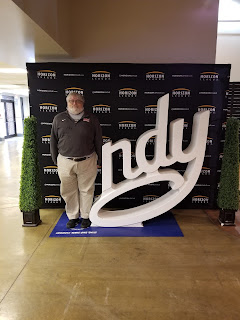
I come to the semifinals and finals of these tournaments (both men's and
women's finish up at the same venue) because I enjoyed Valpo's time in the
Horizon League - which may make me unique among the Valpo fan-base. I
also got to know folks from some of the schools, and as mentioned above, one
of the coaches.
Also, Indiana Farmer's Coliseum is a fairly
comfortable venue to attend games. I meet up every year with a couple
from Green Bay and we just hang out on the mezzanine level on barstools (near
where they serve the alchohol) and watch the games. For the most part
seating is general admission anyway, and the place is never standing room
only, though it's never empty either.
I follow the conference
during the regular season and even go to a handful of games every year, and
maybe even say hi to a few friends along the way.
By the way, the
seeding for the Men's semifinal games might look strange, but the Horizon
League reseeds after every round.
Day 1
Wright State (4) vs. Cleveland State (1) (WBB)
This conference now has 2 perennial powerhouses - Cleveland State and Green
Bay. Charlie Creme at ESPN.com had Green Bay in the first four out and
Cleveland State as the AQ. I had wondered if CSU would get an at-large bid if Green Bay beat the Vikings in the title
game. Kyle Rossi told me not to
count on it, because while the Vikings overall record was better, their
strength of schedule was weak. Kyle covers Horizon League Women's basketball extremely well for the HoriZone Roundtable, a site that continues to be the most dedicated source of Horizon League basketball coverage that I know of.
Anyway the Vikings were thrashing
the Raiders by 30 midway through the 3rd quarter. The game was tight for
the first few minutes, but from then on it was all Vikings.
Ex-Valpo player Sara VanKempen played in this game for Wright State, coming
off the bench.
Purdue Fort Wayne (3) vs. Green Bay (2) (WBB)
This game was much more even than the first one. Green Bay had to
overcome some hot shooting from Amellia Bromenschenkel and limit their turnovers
in the second half to pull this one out.
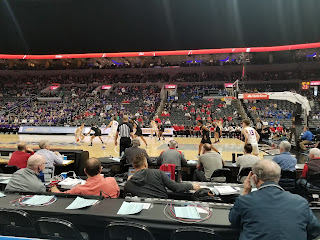
Cleveland State (7) vs. Oakland (1)(MBB)
I got to say hi to Bob McDonald (managing editor of the HoriZone Roundtable) and Neal Ruhl before the game. I rooted
for Oakland to win. Grateful to be able to say hi to coach Kampe after
the game and congratulate him on the win. It was a stressful game
because (1) his team was short handed due to injuries, (2) let's just say the
officiating was substandard in his estimation - so much so that he felt moved
to have conversations with conference officials including the commissioner,
and (3) Cleveland State is just a tough match-up for everyone.
Upon
watching the replay, I saw one play that the broadcast made special note
of. With a 1 point lead late in the 2nd half, Blake Lampmen came around
multiple screens for an easy lane to the basket. He made the layup, but
the Cleveland State player clearly grabbed Lampmen's arm on his way up.
Not only did they not call an intentional foul, they didn't call any kind of
foul. It was an atrocious missed call, and the Horizon League and
Oakland have a right to expect better from referees at their conference
tournament.
Milwaukee (6) vs. NKU (5)
Milwaukee was on a mission in this tournament, and they had the personality for
it. My Green Bay friends rooted wholeheartedly for NKU, but I remained
neutral because I have a few friends within the Milwaukee fan-base.
Milwaukee did win this game, which meant I was able to say hi to my friend
Jimmy Lemke the following night.
Day 2
Green Bay (2) vs. Cleveland State (1)(WBB)
This was the annual screaming rugrats title game (elementary school children from the Indianapolis area flooded the venue for their annual Horizon League tournament field trip). Green Bay dominated
this game almost from the start. It seemed every shot went in for them,
and Cleveland State looked shell-shocked.
Milwaukee (6) vs. Oakland (1)(MBB)
This was an awesome game, and another nerve wracking one for Greg Kampe, I'll
bet. Paul Oren of The Victory Bell decided to come down for this game
(on his way to covering the Lady Beacons in Hoops In The Heartland in
Moline). He was a guest of some Valpo alums who now work for the Horizon
League. As I mentioned above, I met Kampe in 2005. Paul covered
many a Valpo-Oakland game in the Horizon League and possibly even the
Mid-Con. Paul even wrote his own story about his experience at this
game:
Kampe's win brings me great joy
Milwaukee was relentless, even more so than Cleveland State was in the
semifinals. They were still on a mission in this game, and it took a
superlative effort by Trey Townsend and the leadership of Jack Golhke and
Blake Lampen to vanquish them.
At halftime of a very close hard
fought game, I ran into Paul and introduced him to the newest (to me anyway)
in sports-related mixed marriages (Packers-Bears). Honestly, they are
both great friends and it was a great meet-up that culminated in a group
picture taken by the ace photographer who had parked himself next to me and
was shooting pictures of the action...
 |
| Left to right: Jamie Seidl, Sheri Seidl, me, Paul Oren (Photo by Skip Townsend) |
... and just so happened to be Skip Townsend, father of Trey Townsend.
Dad played for Kampe 35 years ago. I found this out because a good
friend from Valpo texted me that I was on TV sitting next to Trey's dad
because the broadcast wanted to highlight him. Turns out he was taking
pictures of his son in action.
This is why I do this - in part, at
least - because something like this might happen, and it is very cool.
It stays with you for awhile. I'll always remember the chance meeting
and the ability to share it with friends.
After the game, and the
post-game celebration including the cutting down of nets, I was allowed to go
on the court and congratulate Coach Kampe and even chat with him a bit.
That too is a great privilege every time I get the chance.
Hoops In the Heartland
This tournament did not live up to the excitement of the first two I went
to. It usually doesn't. The Drake, Illinois State, and
Northern Iowa fan-bases do travel well to this tournament. But I'm
usually all by myself as far as Valpo fans are concerned.
This
year, my seat was much closer to the court and other fans, but I had decided
to do that anyway even if my assigned seat had been near the back. It's no
fun sitting all by yourself.
I also have to say that not every game
made a strong impression on me. For no fault of the participants, I
simply don't have quite as much enthusiasm for women's basketball as I do for
men's basketball. I'm definitely interested or I wouldn't have made the
trip, but it is sometimes a little harder to retain memories of a particular
game.
Day 1
Indiana State (9) vs. Southern Illinois (8)
The story of this game was the 2nd quarter, when the Sycamores went on a bit
of a run that gave them a 10 point lead at halftime. Mya Glanton was a
force in the paint, leading all scorers with 30 points. The Salukis
rallied in the 3rd quarter to cut the deficit to 3, but the Trees put the game
away in the 4th quarter.
Evansville (12) vs. Illinois State (5)
This game carried no surprises. The Redbirds didn't take long to exert
their dominance. Early in the 4th quarter they established a
statistically safe lead, so I decided to get an early start pursuing supper at
the Bent River Brewing Company on 5th Avenue.
Either before the
game or at halftime, I saw someone who looked a lot like Ryan Pedon, ISU Men's
coach, but I dismissed the idea. Turns out my eyes were not deceiving me
after all.
Valpo (10) vs. UIC (7)
Gutted. For the first time since I started coming to this tournament,
Valparaiso was competitive. In fact they had the game won, but ran out
of steam against UIC's superior depth.
Down the stretch,
there were several official reviews that were irritating to those covering the
game. I happened to be tuned into the Valpo radio pbp and they were
constantly standing up with hands outstretched wondering what was going on.
Bradley (11) vs. Murray State (6)
Another blowout, though it didn't start that way at all.
Day 2
Indiana State (9) vs. Drake (1)
This was a blowout too. All game long, the Drake fan on the other side
of the aisle verbally hung on every bounce of the ball and twist or turn in
the action. It was ecstasy or anguish and not much in between.
Illinois State (5) vs. Northern Iowa (4)
Strangely enough, the same fan did the same thing rooting for UNI. He
may just be someone who picks a team to root for and then goes all out.
Or, like other Drake fans also cheering for UNI, this may be an Iowa thing (both
schools are located in that state).
This game was fun and exciting
and even a little physical. UNI kept trying to bury the Redbirds, but
they refused to die until final buzzer.
UIC (7) vs. Belmont (2)
Game of runs early. After trading baskets twice, Belmont ran off 8
straight points. UIC responded with an 11-0 run of their own. An
intentional foul by UIC then sparked a 10-0 run by the Bruins. The first
quarter ended with 4 straight points by UIC.
The Flames continued
an 8-0 run into the second quarter before Belmont hit 2 straight 3s. The
rest of the first half was a little less streaky.
The only thing
certain about the first half (to me anyway) was that UIC had no answer for
Tessa Miller in the low post.
The most dramatic run came in the 4th
quarter. Belmont had a 10 point lead at the start, but it was a nail
biter at crunch time. UIC did not have the magic this time.
This would have been a great win for UIC. For the
second straight year, Belmont finished 2nd in the MVC. Their men's team
might have more notoriety, but their women's team is the real powerhouse.
Murray State (6) vs. Missouri State (3)
Murray State head coach Rochelle Turner was upset with the refs almost from
the jump in this game.
Possibly the most exciting game of the
tournament up to that point. If Bria Sanders-Woods hits both free throws
with 5 seconds to go, we might still be playing. With the score tied at
69, the Murray State player was fouled, but missed the first free throw.
After hitting the second one, the Lady Bears called timeout, moving the ball
to half court. On the ensuing play, Lacy Stokes (who should have made
the all tournament team and I assume she did) drew a foul with 1 second left
and drained both free throws.
The OVC entrants have had miniscule success on the Men's side, but on the
women's side, they both have more than proved their worthiness.
Day 3
Northern Iowa (4) vs. Drake (1)
Another barn burner.
It took until the 4th quarter media timeout
before the UNI band finally broke out the Avengers theme song, as is their
wont. Sure enough at a timeout with 26.3 to go the Drake band countered
with Blitzkrieg Bop (from Spiderman: Homecoming).
First overtime
game of the tournament.
Missouri State (3) vs. Belmont (2)
Lacy Stokes was just too much for the Bruins. Her defense was
suffocating, her pursuit of loose balls was tenacious.
Day 4
Missouri State (3) vs. Drake (1)
Bracketologist at The Athletic thought the Valley had an outside shot at two
bids if the Lady Bears had won this game, but they just couldn't quite pull it
out.
This was a heck of a game with a thrilling/heartbreaking
finish, depending on who you were rooting for. Missouri State went ahead by 1 by hitting a bucket with about 3 seconds remaining, only to see Drake answer back with their own basket at the buzzer.
First Four
Even with something extra-special in Indy this year, the First Four in Dayton is still the best way to end my journey every year. UD Arena is always at least 3/4s packed (and this year all 4 games featured at least one mid-major), and I get to enjoy a nice dinner at the Pine Club with guys like these:

|
| Clockwise from lower right: Me, Ben Case, Steve Timble, and a friend of Ben's (I neglected to get his name) |
If it was nothing but at-large teams, most of them would be from power conferences, and for these former members of the old Mid-Majority, that would be a bummer. In fact, it would probably be enough for us to pass on the trip.
Day 1
Howard (16) vs. Wagner (16)
I often cannot decide who to root for in these games. I don't really
feel like rooting against either team. Unless one of the teams is from
the Horizon League or the MVC, I just root for a good game.
One of
the oddities I remember from this game is that Wagner would struggle on
offense, Howard would poke the ball into the back court, one of the Wagner
guards would rush back to retrieve it, and as the shot clock wound down, he
would storm into the front court and drain a 3 from the top of the key,
beating the shot clock. This happened more than once in the first
half. It's not exactly a good strategy, but hey - whatever works.
The
other noteworthy item in this game is that Wagner only dressed 7
players. They somehow dominated the first half and much of the 2nd half,
but Howard stormed back all of a sudden to make it a one-possession game. They
even cut the deficit to 1 with less than 30 seconds remaining, but Wagner
drained two free throws, and Howard attempted 3 shots beyond the arc but
missed on all three. It was an exciting finish to an otherwise lopsided
game.
Colorado State (10) vs. Virginia (10)
Why they sent 10 seeds here this year is unknown to me. Maybe all the 11
seeds were auto-bids.
This was ex-Drake coach Nico Medvid vs.
ex-Green Bay player Tony Bennett.
I can't help remembering 8
years ago (2016 - the year I met Steve Timble in person) when mid-major fans
reveled in Wichita State absolutely destroying Vanderbilt (who also arguably
did not belong in the tournament). As if to punish me for my enjoyment
of their demise, they let Kevin Stallings go shortly thereafter, and a month
later poached Bryce Drew from Valpo, beginning the slow decline of my favorite
team that continues to this day.
Oh yeah, Colorado State absolutely
obliterated Virginia, if you couldn't tell. I mean, I thoroughly enjoyed
it (no hate for Tony Bennett, who played for Green Bay in the Mid-Con, but
when they move up to the power conferences, I lose any allegiance I might have
had). But there were plenty of knowledgeable pundits who seriously
questioned the Cavs' selection for the tournament. I would have much
rather watched the Sycamores play the Rams in this game.
Day 2
Grambling State (16) vs. Montana State (16)
This game kind of snuck up on me. It felt like a laugher for most of the
first half and into the second half, but then it turned into an exciting
game. Montana State had a comfortable lead, but Grambling State started
pressing mid-way through the second half, and the Bobcats started turning the
ball over. About 5 minutes later we had a barn-burner. The Bobcats
missed a contested layup with 7 seconds to go, but then they defended well on
the other end, and the Tigers came up empty. I think this was the first
overtime game I ever experienced at the First Four.
In the
overtime, Grambling State seized control, but it was Montana State constantly
nipping at their heels, until there was about a minute and half left, when the
Tigers achieved separation once and for all.
Colorado (10) vs. Boise State (10)
If Boise State had won this game, we would have had a mid-major clean sweep at
the First Four, which would have been awesome. Steve and I had the
privilege of sitting just behind a row of kids (they were teens to 20s, but to
this retired guy on Medicare, they're kids). They were mugging for the
camera whenever it was shooting footage of the Boise State cheerleaders just
next door to us. Some rooted for Colorado, others rooted for Boise
State. I was firmly rooting for Boise State. The kid directly in
front of me turned around during the second half and asked if I had money on
the game.
"Hell no! That takes all the fun out of it."
"I
think it actually makes it more fun."
"Some do. Not me."
"You
rooting for Boise State?"
"I always root against power conference
teams. Always!"
It's pretty clear to me that all these kids
had bet on the game, and that gave them a reason to root for whichever team
they were rooting for. A famous (infamous?) sports talker in Chicago
years ago used to espouse the same philosophy on the air. That's how I
knew there were folks who looked at sports that way. I don't get it,
personally, but to each their own. As a matter of fact on Tuesday night, no
sooner had I sat down in my seat for the start of the Wagner-Howard game, but
the young guy (you like that better?) who sat next to me immediately took out
his phone and logged into Fan Duel. I'm betting there was a lot of that
at UD Arena. If that's what people need in order to take an interest in
the First Four, ... who am I to argue (I suppose)?
Alas, the
Broncos could not close it out, so once again at least one power conference
team advanced to the first round.
This was not my most
favorite First Four ever, but that may be because the high point of the trip
was the Horizon League Men's championship game, especially given what Oakland managed
to do in Pittsburgh, which I thoroughly enjoyed at home while resting up from
my adventure. Did you remember I'm an old guy now?